

Many organizations now change technology relentlessly, expect customers to shift, and compete intensely. For them to be successful, clever technology-enabled business models must be adopted. Digital Transformation Solutions arrive here to guide these businesses through change with structure to increase efficiency, improve communication, and ensure long-term growth. This allows companies to flex and resist to operate within a dynamic market.
Digital transformation transforms the culture, workflows, and leadership within an organization. Many organizations have outdated processes, lack sufficient automation, or have disparate data sources that are not interconnected within. Digital transformation solutions assist them in overcoming these challenges. The right transformation provides teams with visibility and control, strengthens operations and creates space for innovation and continual optimization in the long run.
Few leaders deny that digital transformation is key to performance, efficiency and customer trust. This explains the need for resources covering digital transformation fundamentals, strategies, comparisons, examples and practical analyzes to help leaders understand how to choose the right IT strategy. It also helps businesses understand how they can transform to bring meaningful benefits and grow sustainably.
The Foundations and Importance of Digital Transformation
Digital transformation integrates technology into all areas within a business. This fundamentally alters how a company operates and delivers value for its customers. Digital Transformation Solutions architects systems for agility and efficiency so enterprises provide better value for customers using a planned technology application instead of an ad hoc one.
The typical digital transformation process begins by assessing existing workflows. Leaders, consultants, or analysts will study existing communication, bottlenecks, customer interactions, and technology gaps. They measure how much effort is manual, how accurate data is, or how slow performance is. Businesses look for improvements once this analysis is complete. These insights ease the development of digital maximum value strategies.
Digital transformation is key. Consumers increasingly demand a rapid, consistent experience across channels. Teams require current collaboration tools in addition to relevant data access. Businesses need solutions that drive down waste and ease greater transparency and accountability. Without digital transformation initiatives, companies may be stuck in inefficient and sluggish operation. Digital transformation initiatives deliver clarity and stability in the enterprise.
Traditional Operations vs. Digitally Transformed Operations
Feature | Traditional Operations | Digitally Transformed Operations |
Workflow Speed | Slow and manual | Fast with automated and integrated systems |
Customer Engagement | Limited and inconsistent | Personalized with data-driven insights |
Data Management | Fragmented across teams | Centralized for accuracy and visibility |
Scalability | Hard to expand without high costs | Easily scalable with cloud and automation tools |
Digitally transforming enables faster paths to market, lowers costs, and increases customer confidence. Going digital earlier allows organizations to work with greater precision and clarity. The transformation becomes vital as technology advances to remain competitive in the field.
Strategic Components That Shape Effective Transformation
Digital transformation is a conceptual process that needs planning. Companies need Digital Transformation Solutions in order to build a roadmap for all stages of digital transformation. A detailed transformation strategy with the aim to integrate people, processes, and technologies to achieve sustainable change.
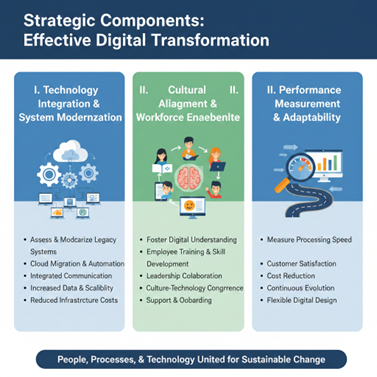
Technology Integration and System Modernization
Technology transforms at its core: change agents adopt technology for automating, analyzing, and collaborating. These tools replace outdated and inefficient legacy systems. IT consultants assess existing technology and recommend modern alternatives to suit business needs. Integrate without friction, so a strong system architecture is needed for ensuring systems are cohesive.
Modernizing systems can include moving systems to the cloud, using automation tools, and integrating new communication systems. These changes increase data availability, reduce infrastructure costs, and make software scalable for users. Automation tools reduce busy-work in addition to new communication systems improving internal workflows. This increases operational reliability.
Cultural Alignment and Workforce Enablement
Transformation is as much cultural as it is technical, hence employees need to understand the potential of digital change and its benefits to the company. Training supports tech adoption. Leaders should collaborate and try errors so employees use new technology.
To enable the workforce, employers onboard, develop skills, and support employees. Employees skilled in digital technology are faster to adopt it. Consulting frameworks are built to help teams learn the tools, and researchers show that culture-technology congruence makes transformations more stable.
An effective strategy includes means for measuring the performance of systems once they are implemented. One can perform measurements like processing speed and customer satisfaction to measure results and direct future actions, in conjunction with how much one reduces costs. Transformation does not happen once and should evolve alongside the maturing organization.
Markets can change rapidly, so designers should transform digital aspects with flexibility in mind. If organizations plan well, they can change and not sacrifice quality or efficiency.
Comparing Digital Transformation Approaches with Practical Insights
Changes happen on different levels for different businesses. Some companies make small changes. Other companies do a complete overhaul. Leaders with understanding of these differences can choose the right path. Digital Transformation Solutions simplify this process with structured assessments and comparison capabilities.
Small scale transformation typically involves individual processes, such as digitizing a customer’s feedback form or automating a process. These early steps lay the groundwork for rapid improvements and the team learns the value of digital. Mid-scale transformation increases IT use in select departments. It improves communication and data visibility. Enterprise-scale transformation changes the systems, roles and workflow of the entire organization and supports sustainable innovation and enduring competitive advantage.
Improvement Levels Across Transformation Approaches
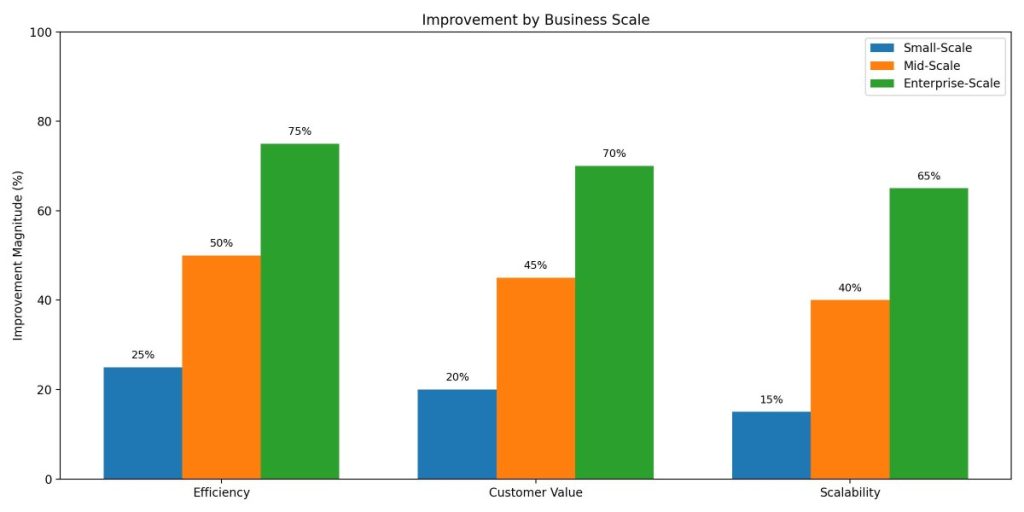
- Enterprise-scale shows the largest gains across all categories (an increase of 65% to 75%).
- Mid-scale improvements to 50% efficiency are often realistic, and well-balanced.
- Small-scale improvements are overall lowest and scalability weakest (15%).
- Small size has 25% efficiency, mid-size has 50% efficiency, and enterprise has 75% efficiency.
- Customer value increases with scale: up to 70% at the enterprise level.
Other examples include a healthcare company greatly improving patient appointment accuracy with the new platform, a manufacturing company reducing downtime using predictive analytics, and a consulting company using cloud integration to form a global collaborative network. These examples show what transformation can help to achieve.
Choice depends on the existing systems, industry maturity and future evolution goals, with smaller changes giving quick results and larger changes providing evolution in the long term. The company and its resources must transform, and consultants help them understand where they can produce meaningful, sustainable value.
Practical Tips for Selecting the Best Transformation Strategy
The proper strategy selection is a key step of digital transformation. Digital Transformation Solutions help companies in making sure that their decisions fit their strategy and resources. A systematic approach helps minimize risks with an increase in adoption.
Analyze your existing infrastructure to see where equipment needs upgrades and processes slow, where technology is lacking and outdated tools affect things. This assessment provides clarity. Next, set transformation goals. Goals can be customer satisfaction, efficiency, scalability, or innovation. A focused strategy allows for superior execution.
It’s important to use technologies that are scalable for growth, can be incorporated over time, are easy to use, and secure. Companies need to be diligent about vendors. A secure, scalable platform matters for sharing sensitive data.
The next step is change management planning. Transformation affects all teams, so clarity is key. Employees need to know about how the new system will improve their job, and training can assist them. Leadership largely determines adoption.
- Evaluate existing workflows and technology depth.
- Set clear objectives and track progress consistently.
- Choose scalable systems that support future needs.
- Provide training to ensure smooth workforce adoption.
Through this process, companies can design transformation strategies that minimize disruptions and produce real improvements.
Building a Strong Future with Digital Transformation
Businesses must digitally transform for economic reasons to develop, and early adopters may compete with an advantage in performance, visibility, and scalability over the long term with Shartor. Digital Transformation Solutions let organizations operate with more efficiency and communicate in a more effective way, while they provide better customer experiences and drive innovation for ensuring stability in rapidly changing environments.
Quality digital strategies help companies become more resilient and efficient, giving to teams the tools they need to improve job focus and accelerating decision-making in the day-to-day. Leaders focus on increased information to plan and support growth. When culture and technology fit, transformation is never finished, but rather continuously integrated into the organization.
It requires dedication, process, and discipline. With the right structures, this can provide reliable short- and long-term company value. Digital transformation is more than technology. It is the strategy that will dictate the future of business. Some organizations invest in systems and develop the skills and capabilities to support innovation.