
Today’s businesses are under pressure to do things faster, smarter and efficiently. Manual operations often slow an organization down and cause errors. Due to the growing importance of process automation, organizations are increasingly asking the question “What Is Process Automation?” The automation of a process refers to technology used to automate activities.
Automation is not only for the big companies anymore. It is used by other small and medium-sized businesses to compete. Routine activities are automated, allowing your team to work strategically and creatively. This change enhances both productivity and employee satisfaction.
Grasping automation is vital before introducing it. Bad implementation can cause confusion rather than fast systems. A definite knowledge leads to better outcomes and sustainable benefits.
This article talks about the meaning, components, advantages, and value of automation. It also suggests on how to choose right one. By the end, you will clearly see how automating supports business success and longevity.
An automated process uses software to perform tasks without human intervention. These tasks typically follow strict rules and repeat often. The use of automation aids in enhancing quality and consistency across processes.
Various departments like finance, customer support, human resources, and IT use automation. Typical examples include processing invoices, entering data, and approving workflows. Automation is a way to lessen reliance on human input.
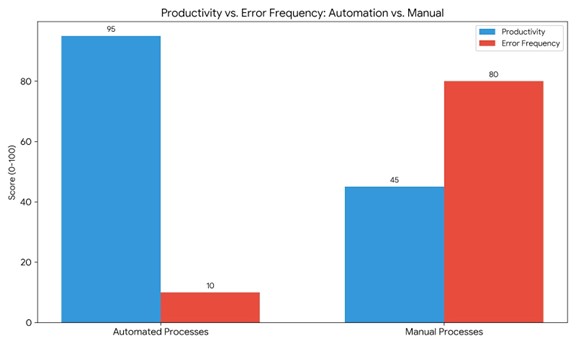
Operational efficiency is the chief benefit. Tasks are completed faster and with fewer errors. As a result, service quality is improved and operational costs cut down.
Automation also helps scale. As companies scale up their operations, so do their automated systems without incurring additional costs. Due to this, automation is more like an investment than a stopgap solution.
Feature | Manual Processes | Automated Processes |
Task Speed | Slow and inconsistent | Fast and reliable |
Error Rate | High due to human input | Minimal and controlled |
Scalability | Limited by workforce | Easily scalable |
Cost Efficiency | Increases with volume | Improves with volume |
Was this table shows how automation may become essential? The use of automated systems yields better results at lower costs.
There isn’t one answer to automation. It consists of other types and parts that cooperate.
Rule-based automation uses established guidelines. It is perfect for predictable and structured tasks. Form validations and scheduled reporting, etc.
This type is easy to implement and manage. It produces fast results for repetitive tasks. Companies frequently initiate automation using rule-based tasks.
Connecting different tasks is workflow automation. This helps in smooth transfer and accountability. It increases the efficiency and transparency of processes.
Combining automation with analytics and decision logic is intelligent automation. It consulting adjusts according to what is provided. More sophisticated business processes can be supported by this approach.
The software platforms integration tools monitoring systems are all Automation components. They work in tandem to enable continuity.
Human effort plays an important part in manual operations. Delays and inconsistencies are often the result of this approach. Automation provides a regular and predictable option.
Choosing the proper automation IT Strategy and Planning. Some processes are more automatable than others.
Begin by pinpointing tasks that repeat and waste time. Clearly-rules process are the most suited ones. This ensures swift implementation and visible results.
Assess the complexity and effect. Automation must offer quantifiable advantages. Well defined goals firmly assess your success.
Think of building upon what you already have. Automation should improve existing workflows, not disrupt them. The compatibility of colours is very important for long-term working.
These steps help organizations prevent automation problems. They also enhance implementation and return on investment.
Process automation is one of the crucial features of business. It enhances efficiency, accuracy, and scalability. Companies who adopt it would have an edge over their competitors.
The above article talked about What Is Process Automation, its key components, and its benefits. Shartor comparison was made with manual operation; implementation strategies were discussed. Each section emphasized its long-lasting worth.
Smart work is more important than hard work. Teams can devote their time to innovations and decisions. This change creates enduring growth.
When you want to be more efficient and resilient, the business will have to automate things. When planned and executed properly, process automation can be hugely successful.
