

PPC Marketing Campaign Services for Smarter Paid Growth
It is quick to get visibility through paid advertising, yet speed does not equate profitable results. An ineffective targeting misallocation of the budget can hinder data gathering. PPC Marketing Campaign…
It is quick to get visibility through paid advertising, yet speed does not equate profitable results. An ineffective targeting misallocation of the budget can hinder data gathering. PPC Marketing Campaign Services enable enterprises to manage paid traffic with better control, greater clarity of objectives and a stronger commercial focus.
A good campaign links audience intent with relevant ads and landing pages. Each click must serve a purpose for you. Whether to generate leads, sales, calls or enquiry. Campaign structure is therefore as important as the ad itself.
Payment seeking reminders likewise offer their own versatility. You can modify budgets, test offers, and improve underperforming campaigns. Nonetheless, the advantages offered are dependent on accurate tracking and ongoing assessment.
PPC, therefore, should be treated as a never-ending performance system by businesses. With careful planning, testing and optimization, advertising spend can be transformed into growth opportunities.
Importance of PPC Campaign Structure
A PPC campaign should start with a clear business goal. Some businesses want online sales instantly, while others rely on phone calls or enquiry forms. With no set outcome, measuring performance is challenging.
Targeting is an important foundation. Advertisers can reach people based on their interests, location, device, and other signals. However, broad targeting may get users who are unlikely to convert.
Campaign structure also affects control. Separate groups may be needed for products, services, audiences, and locations. With clear segmentation, you can better understand where the results are coming from.
Relevance of advertisements is significant because users expect a close relationship between their search and the message. People still click on ads advertising the Wrong service. Those clicks might charge money although they are not useful.
| Campaign Element | Weak Approach | Performance-Focused Approach |
| Targeting | Broad, unclear audiences | Specific commercial audiences |
| Ad Messaging | Generic promotional text | Relevant offers and clear intent |
| Budget Control | Equal spending everywhere | Budget based on performance |
| Landing Pages | General homepage traffic | Dedicated pages for each offer |
| Tracking | Clicks measured alone | Leads, sales, and value measured |
The use of paid advertising services joins these mechanisms, rather than managing them separately. Our goal is not merely to get traffic. The main objective is to produce useful actions at a sustainable cost.
Creating Campaigns with Intention and Impact
Successful PPC management is more than choosing keywords and writing ads. It involves comprehending customer wants, intents and matching those with an accurate offer.
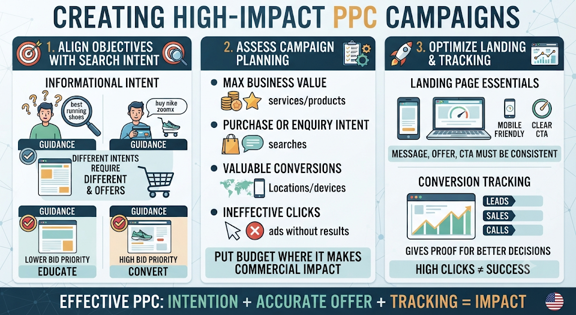
Aligning Campaign Objectives with Search Intent
The phrases searchers use show their level of intent. Some consumers are investigating, while others are prepared to reach out to a provider. The same message should not be sent to these groups.
Commercial focus is warranted for high-intent searches. Landing experience for informational searches may differ or lower bid priority may apply. This difference can save you more.
Campaign planning should normally assess:
- Which Services or Products Provide Maximum Business Value?
- What Searches Show Stronger Purchase Or Enquiry Intent
- Which locations and devices generate valuable conversions?
- Which ads get clicks without effective results?
This strategy helps put budget where it can make larger commercial impact.
Landing pages & conversion tracking
The landing pages are crucial in the after click stage. Visitors can arrive at a confusing page with a powerful advertisement that isn’t effective. The message, offer, and CTA must remain consistent.
Pages need to load quickly and be mobile friendly. Visitors should understand the offer offered by you easily. Forms and contact options should be simple enough to use.
Conversion Tracking Gives You the Proof to Make Better Decisions All campaigns that drive lead generation, sales, or phone calls should be known by businesses. High volume clicks can create an illusion of success without tracking.
PPC Marketing Campaign Services must also evaluate conversion quality. Three qualified prospects are worth more than ten weak inquiries. Businesses require revenue-based or customer value-linked measurements.
Continuous testing may enhance the performance. You can compare ads, landing pages, offers and audiences over time. PPC has developed into a flexible marketing channel and not a fixed cost.
Managed PPC Compared to Unmanaged Advertising
Imagine a fictional company in the home improvement sector running paid campaigns. This company builds one large campaign and sends all traffic to the homepage. The traffic is strong as of now, but enquiries are not consistent.
Issues revealed in campaign review. The budget is being allocated to low-intent searches. The adverts are too general. Furthermore, the services pages do not match visitor expectations. Mobile visitors also have to fill long enquiry form.
The organization segregates services into focused campaigns, boosting negative targeting. Clearer ads and sending visitors to relevant landing pages is what it does. The inquiry form has also been made simple.
The next graph shows the difference between an unstructured campaign and structured management.
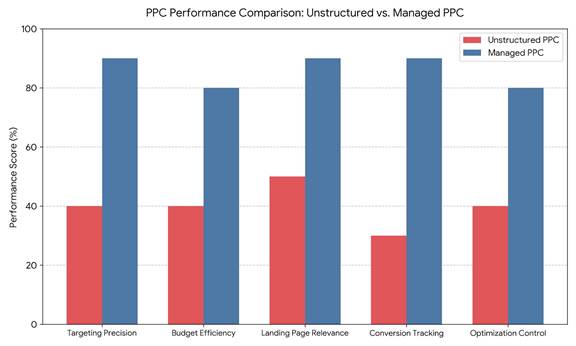
- The targeting precision score for PPC Managed is 90%, while the PPC Unmanaged is 40%.
- The budget efficiency under a managed PPC scenario is 80% as compared to 40% in case of the unstructured one.
- We see 90% Landing Page relevance for managed campaigns versus an overall score of 50% for unstructured campaigns.
Ways to Improve PPC Results
To start, businesses should review the relationship between advertising spend and business outcomes. Just because you have cheap clicks doesn’t mean it’s a successful campaign. It is important to know if these clicks lead to something useful.
Allocation of budget should performance based. Campaigns that convert well may be worthwhile to invest more, while those that convert poorly should be looked into. There shouldn’t be any spending just because this campaign has always been on.
A functional optimization schedule may involve:
- Check search terms and exclude unwanted traffic.
- Review conversion cost by campaign and device.
- Try out even more persuasive ad copy and landing page messages.
- Shift funds to promising projects.
Business should also consider geographic performances. A campaign that reaches a number of places may produce very different results. Changes can enhance efficiency without exceeding the budget.
Device performance also deserves attention. People using Mobile Devices may not behave the same as desktop visitors. The lack of conversions on mobile might be caused by problems with the landing page, not weak demand.
Another approach to control useful is to schedule ads. While certain enterprises receive better quality leads during working hours, ecommerce stores may convert throughout the day. Scheduling decisions ought to be guided by historical performance.
It is essential to review the changes in competition regularly. The continuously changing bids, demand, customer behavior and advertising platforms. A well-performing campaign must be optimized in the future.
Converting Paid Traffic into Tangible Business Growth
When business results are attached to every key decision, PPC is valuable. While clicks and impressions offer helpful context, they should not define success in the final analysis.
With PPC Marketing Campaign Services, businesses can synchronize targeting, ads, budgets, landing pages, and tracking into a single system. This gives better visibility into where advertising money is going.
Managing campaigns effectively leads to continual learning. Businesses will learn about profitable audiences, effective messages and stronger offers. These insights can help improve current campaigns and future marketing choices.
Expectations for paid advertising still need to be sound. Results can change due to competition, pricing, seasonality and website. No matter how careful the management is, the market challenges can never be eliminated.
Effective digital advertising depends on control, relevance, and timing. Shartorhelps businesses reach the right audience, measure ad spend more clearly, and support more predictable growth.

Shartor shares practical ideas around websites, SEO, branding and digital growth.