
Modern businesses rely strongly on technology for their efficient and competitive operation. If tech systems aren’t well-structured, they can become costly and hard to manage. IT Infrastructure Planning Services are involved at this stage. With these services, organizations can design, manage, and scale their IT environment with clarity.
Infrastructure planning isn’t only for big organizations. Small and mid-size businesses also require structured systems for growth. Poorly planned events typically lead to downtimes, security issues and budget overruns. A sound infrastructure plan mitigates these problems before they occur.
Effective planning aligns hardware, software and network with business objective. Ensuring that systems stay dependable, adaptable, and safe over time. Businesses get a roadmap that is proactive rather than reactive.
This essay discusses the need, elements, and advantages of infrastructure planning. It also explains how to choose the best approach for long-term success.
IT infrastructure planning refers to the designing and organizing of technology systems that supports business operations. This includes their servers, networks, storage, applications, security frameworks, etc. A well-conceived plan helps all the parts function together efficiently.
IT environments often grow without plans Performance problems arise, along with increased costs and limited scalability. Planning services create a clear technology road map that addresses these issues.
A well-planned infrastructure caters to both present and future requirements. It enables companies to respond to larger market changes and growth. This versatility is fundamental in today’s rapidly evolving digital environment.
Planning for infrastructure also improves cost control. Businesses steer clear of unnecessary expenditures and make better use of their current resources. This It strategy cuts waste and enhances return on investment.
Aspect | Planned Infrastructure | Unplanned Infrastructure |
Cost Management | Predictable and optimized | Reactive and unpredictable |
System Performance | Stable and efficient | Frequent bottlenecks |
Scalability | Designed for growth | Limited expansion ability |
Risk Management | Proactive risk reduction | High exposure to failures |
The comparison demonstrates that planning is strategically valuable. Structured infrastructure ensures steady business performance.
Infrastructure planning consists of several related systems. All are important for making the system stable and scalable.

The process of planning begins with a detailed assessment Existing systems, workload, and performance gaps reviewed the recommended actions will be customized according to actual business needs.
Requirements should not be over-engineered. Businesses are investing in upgrades only when required. This enhances efficacy and price control.
The infrastructure architecture defines how the system interacts. This consists of network planning, position of servers, and cloud integration. A strong design enhances dependability and simplifies control.
Choosing technology revolves around compatibility and longevity. Planners select solutions to enable future growth This lowers the requirement for repeated replacements.
Infrastructure design incorporates security measures. This includes requiring access control, data security and legal compliance. Planning security from the outset lowers risks later on.
The planning process will address regulatory compliance. It shields companies from legal and operational disruptions.
A lot of companies work with reactive IT management. Problems are fixed after they cause an uproar. Infrastructure planning provides a more strategic option.
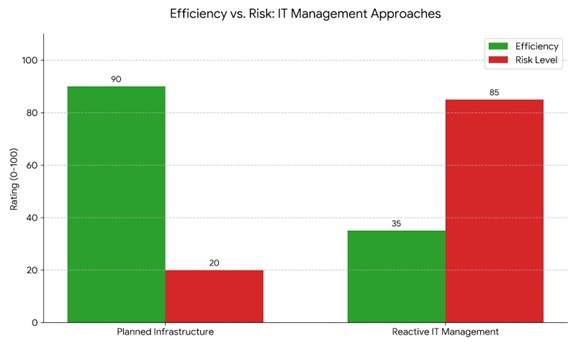
Choosing the appropriate planning model is not easy. The aim is to align business strategy and growth objectives.
Begin with specific primary goals. Know present hurdles and future hopes. This clarity leads to the planning.
Assess proficiency and approach. Planning must be guided by preliminary frameworks and best practices. It is guaranteed to be consistent and reliable.
The ability to grow repeats. Infrastructure strategies must adapt to business growth. Flexible changes avoid expensive design.
These factors help a business in decision making. They also enhance the efficiency of planning outcomes.
IT infrastructure planning helps to aid your business success. It turns technology from a reactive cost to a strategic advantage. Business become more stable and efficient.
In this article, we discussed how IT Infrastructure Planning Services instill an ability for structured growth and reduce risk. Shartor We studied the main elements, comparisons and practical advice on selection. All components help achieve ongoing operational power.
Planning lowers uncertainty and enhances decisions. It guarantees that technology investments provide tangible value. Actively engaged to innovate and remain competitive.
Infrastructure planning is essential for organizations aiming for growth. Businesses can create strong systems that support todays and future success when they employ the right strategy.
